How to Analyze a Football Match: A Step-by-Step Guide
Methodology — 8 April 2026
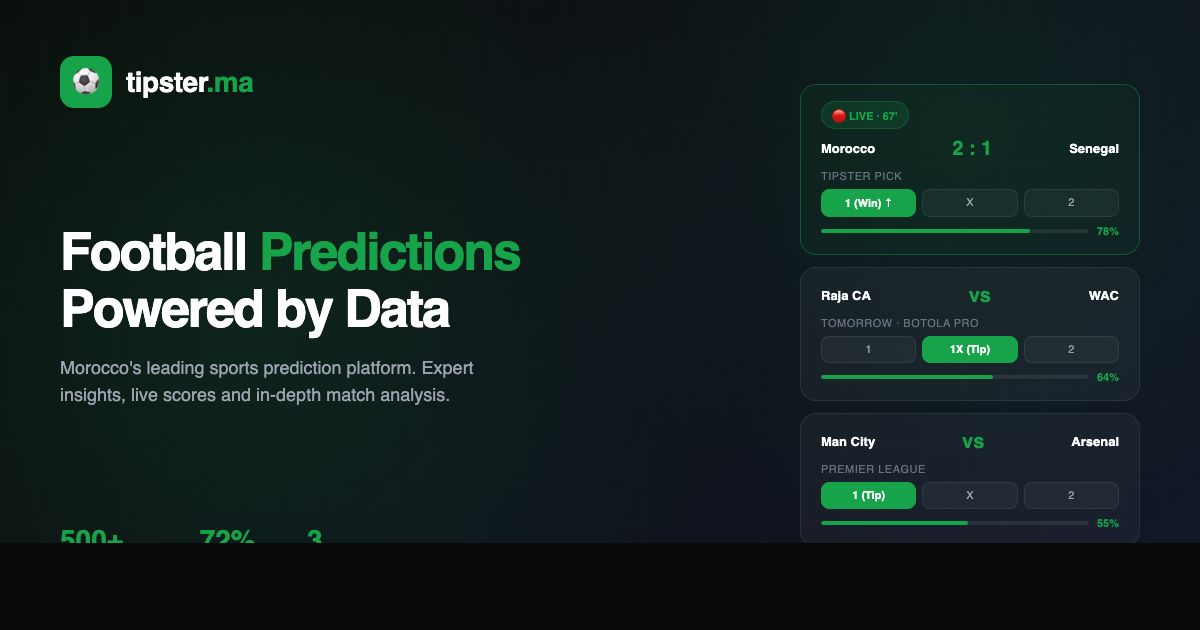
Analyzing a football match on your own requires structure. Rankings, logos and gut feeling are not enough. Here is a clear five-step framework to break down any fixture — and to read football predictions (tips) more critically, including those published on Tipster.ma.
1. Start with recent form
Recent form shows an team's current momentum, far better than its overall league standing.
What to look at:
- The last 5 to 10 matches (all competitions: league, cups, European fixtures).
- The quality of opponents faced: three wins against struggling sides weigh less than a draw earned at a top team.
- Home vs. away splits: many teams look very different depending on the venue.
- Judging from the single most recent result, which can mislead (a 0-0 draw against a deep block is not a bad match for an attacking side).
- Mixing league matches with preseason friendlies without context.
2. Study the head-to-head (H2H)
Head-to-head records are a clue, not a rule. Their weight depends on context.
Things to consider:
- The age of the data: an H2H from 2018 has little value if both clubs have changed coach, system, or lost key players.
- Recency: if a team has won the last four H2H meetings at a specific stadium, there may be a psychological edge worth investigating.
- Squad continuity: a dominant H2H record holds up better when most key players were already involved.
3. Weigh the match context
Context is often where informed analysis separates itself from surface-level predictions.
a) Stakes
- A team fighting for the title or against relegation does not behave like a mid-table side with nothing to play for.
- In cup competitions, rotations are common: a club may field a weakened XI in the league to protect starters.
- Derbies and emotionally loaded fixtures can produce unusual results.
b) Absences and injuries
- Check the injury, suspension and fatigue lists.
- Some positions matter more than others: the absence of a starting goalkeeper or a 20-goal striker is more damaging than a missing rotational midfielder.
- Watch pre-match press conferences and last-minute team news for "doubtful" players.
c) Schedule
- A midweek match after a European away trip can explain a drop in intensity.
- Conversely, a team with a full week of rest often looks sharper.
- End-of-season fixtures are tricky: clubs on holiday, or clubs with nothing left to play for.
4. Make sense of xG data
Expected Goals (xG) measure the quality of chances created and conceded, independently of the final score.
- xG per match: indicates a team's actual offensive threat. A team consistently outperforming its xG may be on a lucky streak — and due for a "correction".
- xG against (xGA): reflects defensive solidity.
- xG per shot, shots on target, xGOT (post-shot xG): add nuance around finishing and goalkeeper efficiency.
- xG does not capture everything: a clinical finisher or a wasteful striker can diverge from the average over the long run.
- Match context (high press, positional play, fast transitions) heavily influences expected xG outputs.
5. Reading a tip: odds and confidence
A tip is not an order. It comes with two key indicators: the odds and the confidence level.
Odds
Odds express the market's implied probability. Odds of 2.00 roughly translate to a 50% probability, according to bookmakers. Higher odds mean a less probable outcome — and a higher payout if it lands.Comparing the tipster's quoted odds with the market helps you see whether the analysis agrees with or pushes against the bookmakers. Both approaches are legitimate; they reflect different reads of the match.
Confidence level
On Tipster.ma, every free tip is published with a confidence rating and its odds. The confidence level reflects how aligned the indicators (form, context, xG) appear at the moment of publication. High confidence usually signals strong convergence of factors; lower confidence flags at least one unstable element (last-minute injury, ambiguous H2H, etc.).Public record
Tipster.ma publishes its results transparently: every free tip is shown with its outcome (won or lost). This lets readers verify the recent track record themselves, instead of relying on empty promises. No system is infallible; checking the history helps calibrate how you read future tips.Conclusion
Analyzing a match means stacking clues — form, H2H, context, xG — and then interpreting any tip through its odds and confidence. This method guarantees nothing; it removes guesswork. And in a sport where the unexpected is the rule, that already counts for a lot.
Disclaimer: Tips and analyses published on Tipster.ma are provided for informational and educational purposes only. They do not constitute financial, investment, or betting advice. Sports betting carries a risk of financial loss. Please gamble responsibly, set a budget you can afford to lose, and reach out to a specialized helpline if you feel you are losing control.